Named
Your brand appears in the answer text, even if you are not the pick.
Learn
To track AI search visibility, run a fixed set of buyer prompts across ChatGPT, Claude, Gemini, Perplexity, Grok and Muse on a schedule, then record whether your brand was named, recommended or cited, and which URLs were used as sources. Traditional Google rank tracking and Search Console alone do not show this.
AI search visibility is not a Google ranking. It is whether assistants name you, recommend you, or cite your pages when buyers ask.
Your brand appears in the answer text, even if you are not the pick.
The answer actively steers the reader toward you as a choice.
Your URL is used as a source. Counted only when citation evidence exists.
Classic rankings and Search Console still matter for Google. They do not show whether ChatGPT or Gemini mentioned you. Read how GapStack measures Named, Recommended and Cited.
Five practical steps. Start with Free Gap Check if you want one prompt across ChatGPT, Gemini and Perplexity before you wire a full schedule.
Write the buyer questions people ask when they discover, compare or choose a supplier in your category. Keep the wording stable so week-to-week changes are real.
Cover ChatGPT, Claude, Gemini, Perplexity, Grok and Muse. Buyers move between assistants, so a single-engine snapshot is easy to misread.
Use a weekly Pulse across every tracked prompt for the trend, and Daily Watch on the prompts that matter most so a lost recommendation shows up the next morning.
Measure share of voice against the brands you actually compete with, not an opaque industry average.
When a competitor is named or recommended and you are not, open a Gap with the answer evidence attached and fix the page or mention graph behind it.
GapStack records the answers behind every rate so you can see Named, Recommended and Cited with the sources attached.
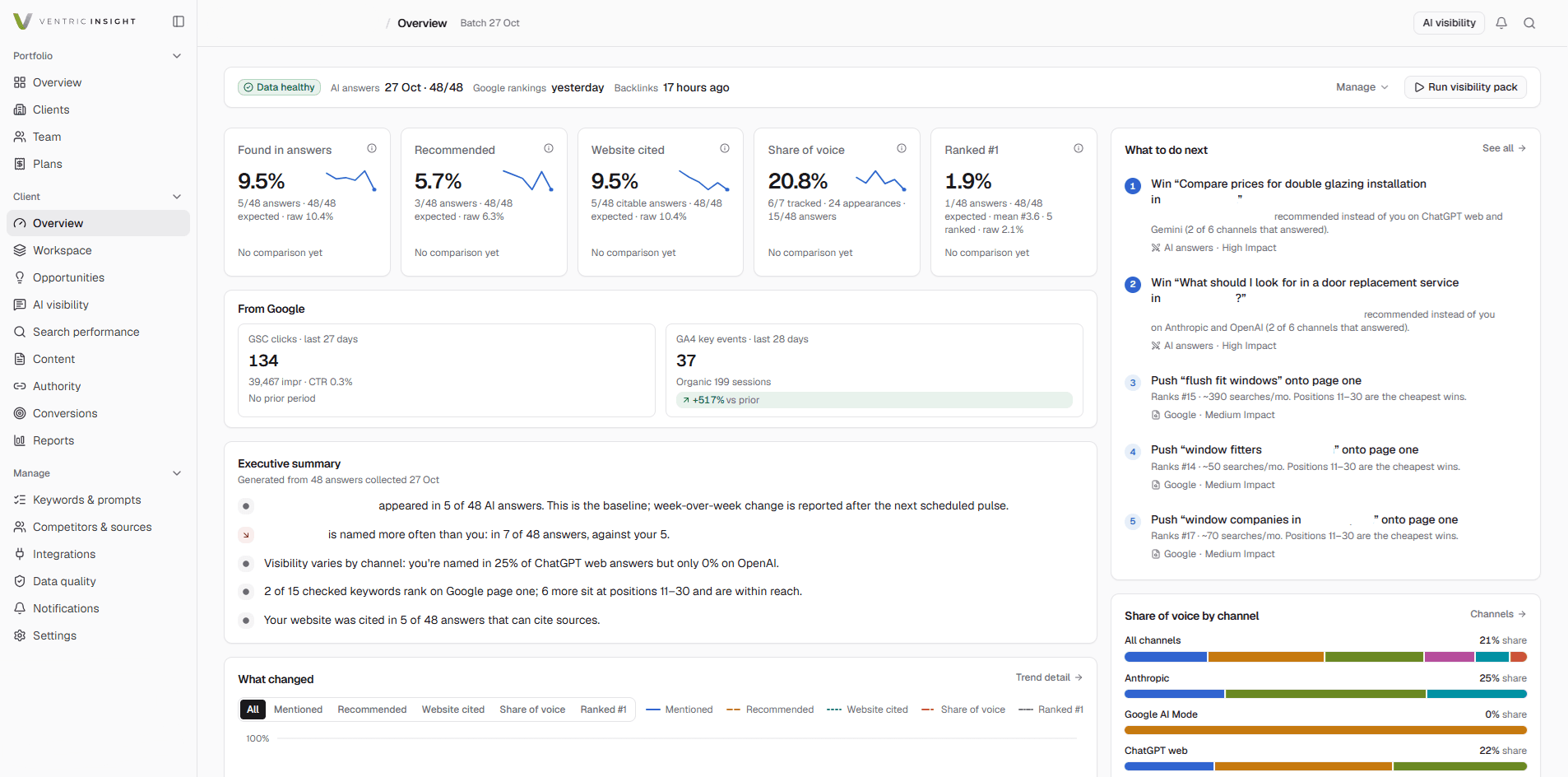
Product overview with Ventric demo data, scrubbed for marketing.
Keep the signals separate. Being found is not the same as being recommended, and neither is the same as being cited.
How often your brand appears in successful answers for the prompts you track.
How often the answer actively recommends you, counted separately from a bare mention.
How often your website is used as a source, measured only where citation evidence exists.
Your share of appearances among the competitors you chose to track. Empty sets stay N/A, never a fake zero.
Which URLs models trust enough to cite, so you know what to strengthen or replicate.
Different tools answer different jobs. Pick based on whether you need brand mentions, suite research, AI-only tracking, or search plus AI with Gaps.
| Type | Examples | Best fit |
|---|---|---|
| Brand mention monitors | Mention, Brand24 | Useful for press and social brand mentions. They are not built to score Named, Recommended and Cited across AI answer engines on a prompt pack. |
| SEO suite add-ons | Semrush, Ahrefs, SE RankingCompare GapStack with SEO suites | Strong for classic SEO research. AI visibility is usually an add-on with its own limits, not always paired with daily ranks and Gaps in one agency workspace. |
| AI-only trackers | Peec AI, OtterlyGapStack vs Peec AIGapStack vs OtterlyAll comparisons | Focused on AI answers. Compare GapStack with Peec AI and Otterly if you want a dedicated AI tracker without search ranks, Search Console and Gaps beside it. |
| GapStack | Search + AI + Gaps + MCP | Tracks Google rankings and AI answers side by side, turns misses into prioritised Gaps, and connects evidence to Cursor, Claude, GitHub Copilot or Grok via MCP. |
Fair facts only. No star ratings or invented review scores. For prices, engines and allowances side by side, see Compare GapStack.
If you are choosing an AI search visibility tool, use this list as a buyer checklist.
Run the same buyer prompts on a schedule across ChatGPT, Claude, Gemini, Perplexity, Grok and Muse. Record whether your brand was named, recommended or cited, and which URLs were cited. GapStack does this with Weekly Pulse and Daily Watch, and Free Gap Check is the zero-setup starting point.
No. Search Console and Analytics show Google search and site behaviour. They do not tell you whether ChatGPT, Claude, Gemini or other assistants named, recommended or cited your brand. You need prompt-based AI answer checks for that.
Look for controllable prompt packs, multi-engine coverage, Named vs Recommended vs Cited measured separately, citation evidence, a disclosed competitor set, an honest weekly vs daily cadence, Google ranks beside AI answers, prioritised Gaps, and a way to hand evidence to your team or an AI assistant (API or MCP).
Decide whether you need AI answers alone or search plus AI in one place. Check which engines sit on the entry plan, how often prompts are re-checked, whether citations include evidence, how competitors are defined, and whether misses become a work list. Then use the GapStack Compare hub for fair side-by-sides, including GapStack vs Peec AI and GapStack vs Otterly.
Peec AI is an AI-focused visibility tracker. SE Ranking is an SEO suite with an AI visibility toolkit as part of a broader research product. GapStack combines daily Google ranks, AI answer tracking on every engine and plan, prioritised Gaps, and MCP so evidence can reach Cursor, Claude, GitHub Copilot or Grok. See the Compare hub for the sourced matrix, including SE Ranking.
Run Free Gap Check in minutes, or open the product tour for Weekly Pulse, Daily Watch and Gaps.